SPOTLIGHT ON AUTHOR RANDY OVERBECK

Dr. Randy Overbeck is an award-winning educator, bestselling author, popular podcaster and speaker in much demand. After serving children for almost four decades as teacher, college prof and school leader, he used those experiences and skills to craft captivating mysteries, thrillers and historical suspense. His novels have earned more than a dozen national awards including Thriller of the Year, Best Book Award, the Gold Award and Mystery of the Year and have garnered hundreds of five-star reviews on Amazon, Goodreads and BookBub.

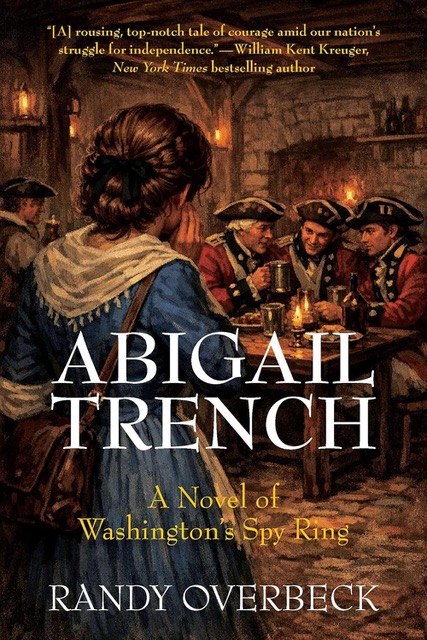
His newest novel, ABIGAIL TRENCH, is a historical suspense about the Revolutionary War, released June, 2026 by Diversion Books and distributed by Simon and Schuster.

Dr. Overbeck is also the host of the popular podcast, Great Stories about Great Storytellers, which reveals the little known backstories of famous authors, directors and poets and ranks among the top 50% of all podcasts in the US. When he is not writing or podcasting, he is in much demand as a speaker, sharing informative and entertaining programs to more than 300 groups all over the country.


Blurb:

A vivid, propulsive Revolutionary-era thriller with the spy-craft verve of the streaming hit TURN: Washington’s Spies and the electricity of 1776’s New York that Hamilton lovers will recognize, this story is inspired by the lone female operative in Washington’s spy ring.

In occupied New York, a schoolteacher with everything to lose turns information into a weapon, threading between Redcoats and rebels as plots against Washington gather steam.

After rogue Redcoats assault her and strip her family’s Long Island farm, Abigail Trench fights to survive in New York City—tutoring in a high-ranking British officer’s Water Street household by day, navigating taverns, informants, and soldiers by night. Through Abigail’s keen eyes—and a counter-narrative following a principled British major—the novel renders the moral gray zones of occupation with gritty intimacy. As rumors swirl of a strike at General Washington, Abigail’s vantage inside upper-crust parlors and rough waterfront rooms makes her an ideal courier—and a target.

This historical thriller delivers high tension, textured world-building, and a captivating heroine who put it all on the line for freedom.

Well, here we are, and I realised it was high time I poked around with a few questions of my own. The sort of things people are always secretly curious about — and, luckily for us, Randy has been more than happy to share.

So to my first question, Randy: What was the first trigger that made this story impossible to ignore?


RANDY: When I researched the Culper Ring, Washington’s secret spy ring that helped win the Revolutionary War, I was fascinated by the tale of the lone female operative. Known only as agent 355 and only that she helped uncover a few British secrets, most of her courageous story has been lost to history. With what little we know about her, I thought it was a story begging to be written. For my novel, ABIGAIL TRENCH, I used the few surviving details and created a fictional character to step into those historical shoes.

That’s wonderful to hear, Randy, I love a good story centred around strong women – and especially the notion of her being a spy, of which there have been many unsung heros. So which character surprised you the most while writing?


RANDY: When I was preparing for the novel, I researched likely characters from 1776 New York City my Abigail might meet and I ended up with the character of Molly, a sixteen-year-old girl with no family and a boyfriend. Abigail, a teacher and a tutor, learns some of the harsh realities of life in colonial New York from this teen who has to earn her living  “serving men” on the street. Abigail is both surprised and enlightened by her new young friend.


It’s amazing when a character evolves from simply no-where but has purpose. I love that! I am now wondering which scene was the hardest to write?


RANDY: Much of the novel required extensive research to ensure I captured the 1770’s colony of New York  accurately but no scene more so than the one aboard the prison ship, The Jersey. The British used derelict ships to hold captured prisoners of war and kept the captives in incredibly inhumane conditions. In the novel, Abigail obtains permission to visit her brother who was captured at the battle of Fort Washington aboard The Jersey. I found it difficult to find the right words to capture the unbelievable horrors inside that ship. FYI: most of the prisoners aboard such British ships died from starvation and disease.


When we look back in history some things in history should never be. How one human can treat another so shockingly I will never understand. But wouldn’t it be wonderful if we could change the tide of history, and learn never to repeat it.  I wonder though if we ever will.

On a lighter note: What does a typical writing day look like for you to write, and why?


RANDY: A mentor author gave me this advice: I don’t care what you write, but write everyday. That’s what I try to do, well almost everyday. I find morning best for inspiration from my muse—though I don’t do early morning any more. II did that for 40 years in education and don’t like those wee hours of the morn.  With a cup of tea and perhaps a Danish if I’m lucky, I find the words flow best for about two or three hours, then I need to move on to something else. But I’m always back the next morning ready to write again. Well, almost always.’

We all need somewhere to write – do you have a special writing space?

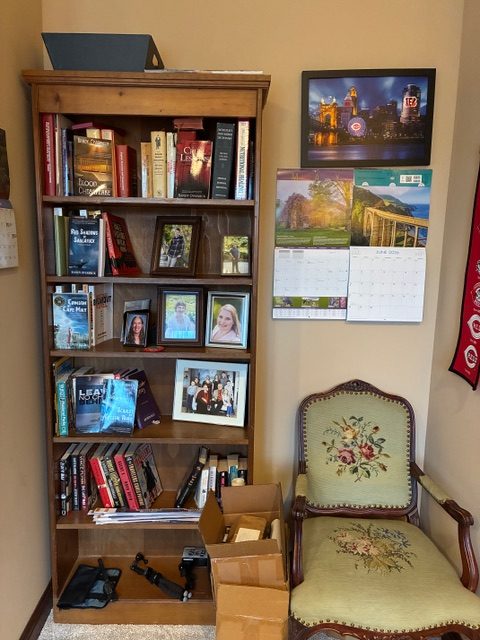
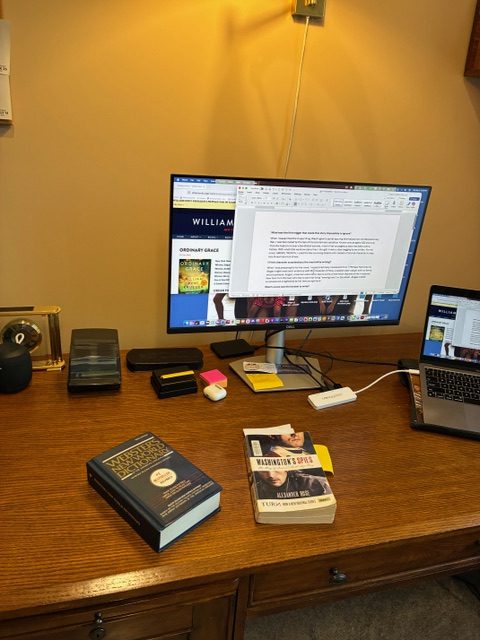
RANDY: I’m very fortunate to have a great space to create my stories. When we built our house several years ago, we designed my office with an expansive window looking out on woods and a pond in our sub. I have a gorgeous L-shaped wooden desk with a large monitor—my eyesight is not as good as it once was. I’m surrounded with a bookcase of inspiration, including copies of my six novels, as well pictures of my family. I find when I enter my office and start writing, the rest of the world slips away.

You are really lucky, and thank you for sharing.  Possibly like yourself, once I get on my laptop, I’m talking to my characters, mostly being bossed around, and then lost for hours creating a completely different world.

Randy, while this isn’t my last question, I feel the need to ask about research. It’s a really big part of your story. I know how important it is to get it right for your readers – being as honest, and as knowledgeable about the period as possible. Like most of us, sometimes we come across something exciting, distracting or completely off the wall – what’s the strangest thing you discovered while researching?

RANDY:  In researching this era, I was stunned by details about the American Revolution I discovered but had never learned. Here’s an example: In June, 1776, a man named Thomas Hickey, who was a bodyguard of Washington and had conspired to assassinate him, is
hanged. The largest crowd ever to witness a hanging was present, between 10,000 and 20,000 spectators, according to the personal memoirs in the historical records. Through high school, college, graduate school and doctoral studies, I’d never heard of this event. And a great deal more that I incorporated in my novel.’

Oh, wow. That’s absolutely incredible and so bloodthirsty – it always reminds me how essential it is to learn from our past. If only we did.

How do you know when a book is done? Or how do you let go? 

RANDY: That’s a difficult question. Before I complete a novel, I will write, rewrite and revise each page and each chapter several time before I’m satisfied. As I’m nearing the end of this revision process, I’ll share my manuscript with an editor I trust to do a diagnostic edit of my work. She is quite talented and gives me insight into how to make my work the best it can be. Once I make the changes recommended, I’m usually satisfied it is ready for submission. Besides, I realize the publisher’s editor will have her go at it as well. I’m not Sure that means I’m done. I’ve picked up a page or chapter from one of my earlier books, like Blood on the Chesapeake,  and I read the section and see something I could make better, tighter, more descriptive. Then I take a breath and move on.


Good plan, Randy. I’ve just started setting out my first audio book from my debut – some things I know need to be tweaked, so I need to take note!

So which writers or books shaped you the most?

RANDY: I have been very fortunate to know and learn from a number of successful and best-selling authors at writing conferences. Two writers in particular have helped to shape the writing of my new historical fiction. Ken Follett is the most successful writer of historical fiction and I’ve read pretty much every historical novel he’s written. From his writing , I tried to learn how to tell a compelling historical narrative through the eyes of ordinary people. Something he excels at. 

My other shout out is to William Kent Kreuger, author, mentor and friend. While he is most famous for his best-selling mysteries, the Cork O’Connor series, his historical novels are
equally as good and one (Ordinary Grace) has won the Edgar, Anthony and
Macavity awards. His writing in mysteries or historicals is remarkable in many
ways but I believe Kent does a better job of capturing a scene vividly than
anyone else—whether the setting is the Mississippi River of the 1930’s or
present-day Boundary Waters in northern Minnesota. Reading and studying his
work, I’ve tried to learn how to raise the bar on my scene writing as well.
Well Randy, I would like to thank you once again for returning to my blog and sharing so much information. I found it fascinating. I am sure my readers will too. 

To my fabulous readers, thank you for joining us today, and if you would like to know more about Randy’s extensive range of novels and his new release:

ABIGAIL TRENCH

Please find below Randy’s social media and links

Oh, and one last word from me. We would love to hear from you. So please let us know what you think, and if you have a burning question – all things writerly of course, we would be delighted to reply. All you need do is scroll to the bottom of the page to comments.

And if you’re searching for more historical novels try this:

Comments (3)

  • Lynn Griffin

    Lovely to have you with us today, Randy. Wishing you ever success with Abigail Tench

  • Randy Overbeck

    Thanks so much for hosting me. I truly enjoyed sharing some of the insights I gained writing ABIGAIL TRENCH.

    • manager

      So good to have you back, Randy. Every success.

Leave a Reply

Your email address will not be published. Required fields are marked *

The impact of well-crafted website content cannot be overstated and can be the difference between a thriving online presence and a lackluster one.